Your Brand. Your Clients. Our Execution.
"Will they go around me and talk to my clients directly?"
"We tried offshore before. The quality was terrible."
"How do I know this won't create more work for me?"
| Typical Capacity Model | Logiframe |
|---|---|
People to manage |
✅ Managed delivery system |
You own the oversight burden |
✅ Built-in QC and review process |
Ends at placement or go-live |
✅ Stays until it works |
Workflows live in people's heads |
✅ Documented SOPs you always have access to |
You manage quality day to day |
✅ Monthly progress report — what was done, reviewed, and flagged |
Phase 1. Start here.
Extend your capacity under your brand
We handle your client overflow — bookkeeping, reconciliations, basic reporting — invisibly, under your brand. Your clients never know we're there. You stay in full control of every relationship.
→ Partner Capacity Model
Phase 2. Go deeper.
Say yes to more complex client work
When a client needs a cleanup, a close process overhaul, or better reporting — you can now say yes. We do the work. You deliver the result. Your firm's capability expands without adding headcount.
→ Stabilization for Your Client
Phase 3. Full Capability.
Offer Xero, NetSuite & HubSpot to your clients
When your clients need systems implemented and working — your firm can now offer that capability. We implement and stay post-go-live. You expand your service line without building a new team from scratch.
→ Systems for Your Clients
Phase 1. Capacity Extension.
Scale implementation capacity without hiring
When project load exceeds your team's bandwidth, we step in as your delivery extension — implementation support, configuration, testing, and documentation under your oversight and standards.
→ Implementation Delivery Support
Phase 2. Post Go-Live.
Stay after go-live so adoption actually happens
Most ERP projects stall after go-live. We provide managed finance operations support — helping your clients' teams actually adopt the system and run their processes through it consistently.
→ Managed Operation Support
Phase 3. Growth Enablement.
Help your clients grow their pipeline with HubSpot
When your clients need CRM alignment to grow — HubSpot implementation, process design, and pipeline visibility. A natural extension of the systems relationship you already have with them.
→ HubSpot CRM Implementation
Our U.S. practice launched in 2026, and we are building it the same way we built the first one: one engagement at a time, with the founder directly involved. We would rather earn trust slowly than scale before the quality is proven.
A U.S. wealth management firm was spending too much internal time on client bookkeeping — work that needed to be done carefully, consistently, and completely invisibly to their end clients.
They were cautious about offshore delivery. Quality and discretion were non-negotiable.
We handle their client bookkeeping today — under their brand, to their standards, with zero direct contact with their clients. They review. They approve. Their clients see only them.
Now in the U.S. to serve you directly.
_2000_2000.webp)
Non-compete by commitment.


-
Will you ever go directly to my client?
Never. We operate exclusively under your brand with zero direct contact with your end clients. We work for you — not around you. Your client relationships are yours, always. We put that commitment in writing so you never have to rely on our word alone.
-
How do you handle client confidential data?
Client data is accessed only by the team members assigned to that specific engagement — no one else. We follow your data handling protocols, work within the systems you already use, and never store client data outside of agreed platforms. Access controls and system permissions are set up by you and reviewed at onboarding.
-
Will you sign a non-disclosure agreement?
Yes. Before any work begins we sign a mutual NDA covering all client information, engagement details, and any proprietary processes or workflows you share with us. Confidentiality is a baseline, not a negotiation point.
-
What happen if I want to end the engagement?
You can exit with reasonable notice of 30 days. All documentation, SOPs, and work product belong to you. We do a structured offboarding to ensure nothing is lost in transition. There is no lock-in by design — we want you to stay because the quality is good, not because leaving is difficult.
-
We tried offshore before and it didn't work. Why is this different?
Most offshore failures come from two things — unstructured handoffs and no accountability for quality. We address both directly. Every engagement starts with documented SOPs built to your standards. Every piece of work goes through a maker-checker-reviewer process before it reaches you. And every month you receive a clear progress report so you always know what was completed, reviewed, and flagged. Structure is what makes the difference — not location.
-
What happens if quality drops or something goes wrong?
We flag issues before they reach you wherever possible. If something does get through and you identify an error, we fix it immediately — no debate, no delay. We then trace back through the review process to understand where the breakdown happened and update the SOP to prevent recurrence. You receive a clear explanation of what happened and what changed. Mistakes are treated as process failures, not personnel failures.
-
Will this create more management work for me?
Our goal is the opposite. We onboard to your standards, follow your review process, and flag issues before they escalate. The monthly progress report gives you full visibility without requiring daily oversight. Most partners find that their management burden decreases once the SOPs are established — because the process runs itself rather than depending on constant direction from you.
-
What accounting systems does your team work in?
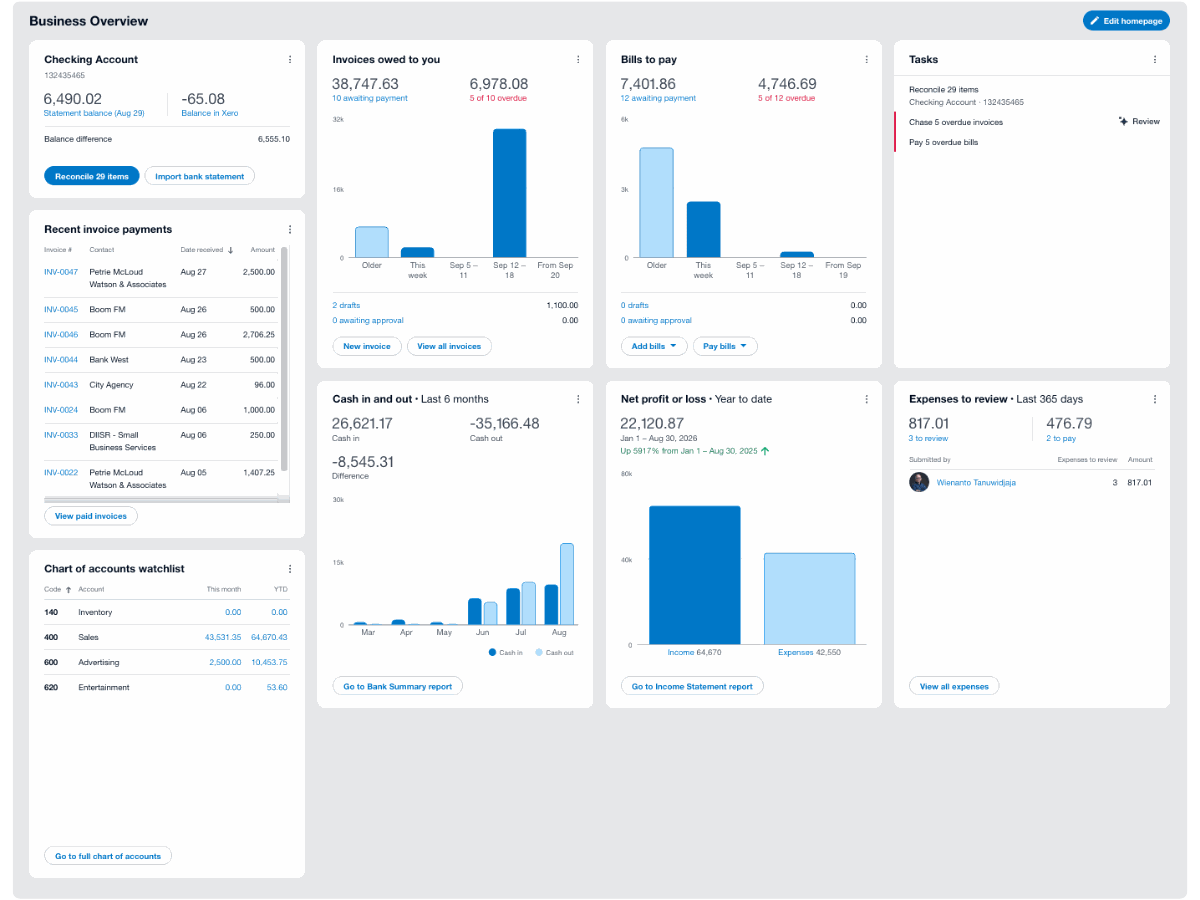
We are proficient across QuickBooks Online, Xero, and Oracle NetSuite for accounting operations. We also work in HubSpot for CRM and pipeline alignment. Beyond operating within these tools, we understand their architecture well enough to redesign processes and improve how they are being used — not just execute tasks inside them.
-
My firm uses Xero but we don't have deep Xero expertise. Can you help?
Yes. This is one of the most common situations we work with. If your firm has clients on Xero but your team's Xero knowledge is limited, we can provide the technical Xero capability — implementation, setup, process design, and ongoing support — while you retain the client relationship and deliver the outcome under your brand.
-
Can you help with NetSuite implementation for our clients?
Yes. We handle NetSuite implementation, process redesign, and — critically — post-go-live support to ensure the system is actually adopted and used. Most NetSuite projects stall after go-live because the implementation team leaves. We stay until your client's team is running their operations through the system consistently.
-
Do you work within our existing tech stack or do you require specific tools?
We work within your existing stack wherever possible. We do not require you to purchase new software or change your workflows to accommodate us. At onboarding we review the tools you and your clients use, confirm access and permissions, and build our SOPs around your current setup.
-
Who are the people actually doing the work?
Our delivery team is based in Indonesia — accounting and finance professionals trained to U.S. reporting and quality standards. Every team member is assigned to a specific pod with a defined role. You work with the same people consistently, not a rotating pool of anonymous staff. The founder oversees every engagement directly, particularly in the early stages.
-
How do you handle time zones and communication?
Our team operates with significant overlap to U.S. business hours. For day-to-day work, tasks submitted by end of U.S. business day are typically processed and ready for review the following morning. For urgent items, we establish a clear escalation path at onboarding. Communication runs through whichever channel you prefer — email, Slack, or your existing project management tool.
-
Can we scale up or down as our client load changes?
Yes. The model is designed to flex with your firm's needs. If you bring on more clients and need additional capacity, we scale the team pod accordingly. If a client relationship ends or workload reduces, we adjust. We ask for reasonable notice — typically 30 days — for significant capacity changes so we can plan properly without disrupting quality.
-
What work is in scope and what is out of scope?
In scope: bookkeeping, reconciliations, accounts payable and receivable processing, close support, management reporting, and system operations within QBO, Xero, NetSuite, and HubSpot. Out of scope: tax filing, legal advice, audit sign-off, and any work requiring a licensed U.S. CPA. We are clear about these boundaries at onboarding so there are no surprises.
-
How does pricing work?
The Partner Capacity Model is priced as a monthly retainer per team pod — predictable, recurring, and scoped to the volume of work agreed at onboarding. Extended service engagements such as finance stabilization, Xero or NetSuite implementation, and HubSpot setup are scoped and quoted as fixed-price projects. There are no hidden fees and no hourly billing surprises.
-
Is there a minimum commitment period?
We offer a 60-day pilot before any longer commitment is required. After the pilot, engagements run on a rolling monthly basis with 30 days notice to exit. We do not lock partners into long-term contracts — we earn the ongoing relationship through the quality of our work.
-
How do you protect our firm's margins?
Our cost structure is designed to improve your margins, not compress them. Because our delivery team is based in Indonesia, you access finance-trained capacity at a significantly lower cost than equivalent U.S. hires — while charging your clients at your standard rates. The difference is your margin improvement. We can work through the numbers with you during the discovery call.
-
Do you compete on price?
No. We are not the cheapest option and we do not try to be. There are lower-cost offshore providers — but lower cost typically means less structure, less accountability, and more risk for your firm. We compete on quality, reliability, and the trust our partners place in us. If price is the primary decision factor, we are probably not the right fit — and we would rather be honest about that upfront.
-
Can we start with just one client as a pilot?
Yes — and we recommend it. Most partners start with one low-stakes client for 60 days. You see the quality firsthand, your team gets comfortable with the handoff process, and you decide how to expand from there. Starting small is the right way to build a partnership like this — no pressure to commit more than you are ready for.
-
How long does onboarding take?
Most engagements are operational within 3–4 weeks from the decision to proceed. This includes an initial discovery session to understand your workflows and standards, SOP documentation, system access setup, a review hierarchy walkthrough, and a supervised trial run before going live with client work. We do not cut corners on onboarding — it is where the quality foundation is built.
-
What does the discovery call involve?
A 45-minute conversation — no pitch deck, no hard sell. We ask about your current capacity situation, which clients or service lines are creating the most pressure, what systems you use, and what a successful partnership would look like for your firm. At the end we either recommend a specific engagement model or tell you honestly if we are not the right fit.
-
How do we get started?
Book a discovery call using the button below. We will confirm a time within one business day. If you prefer to ask a question before committing to a call, you are welcome to email directly at wienanto.tanuwidjaja@logiframe.com — and you will hear back from the founder, not a sales team.

.png?width=141&height=85&name=logiframe-png%20(2).png)