
Services
Monthly bookkeeping run entirely in Xero — closed, reviewed and proven every period by the team that does the work.
Bookkeeping packages

Xero Accounts Receivable
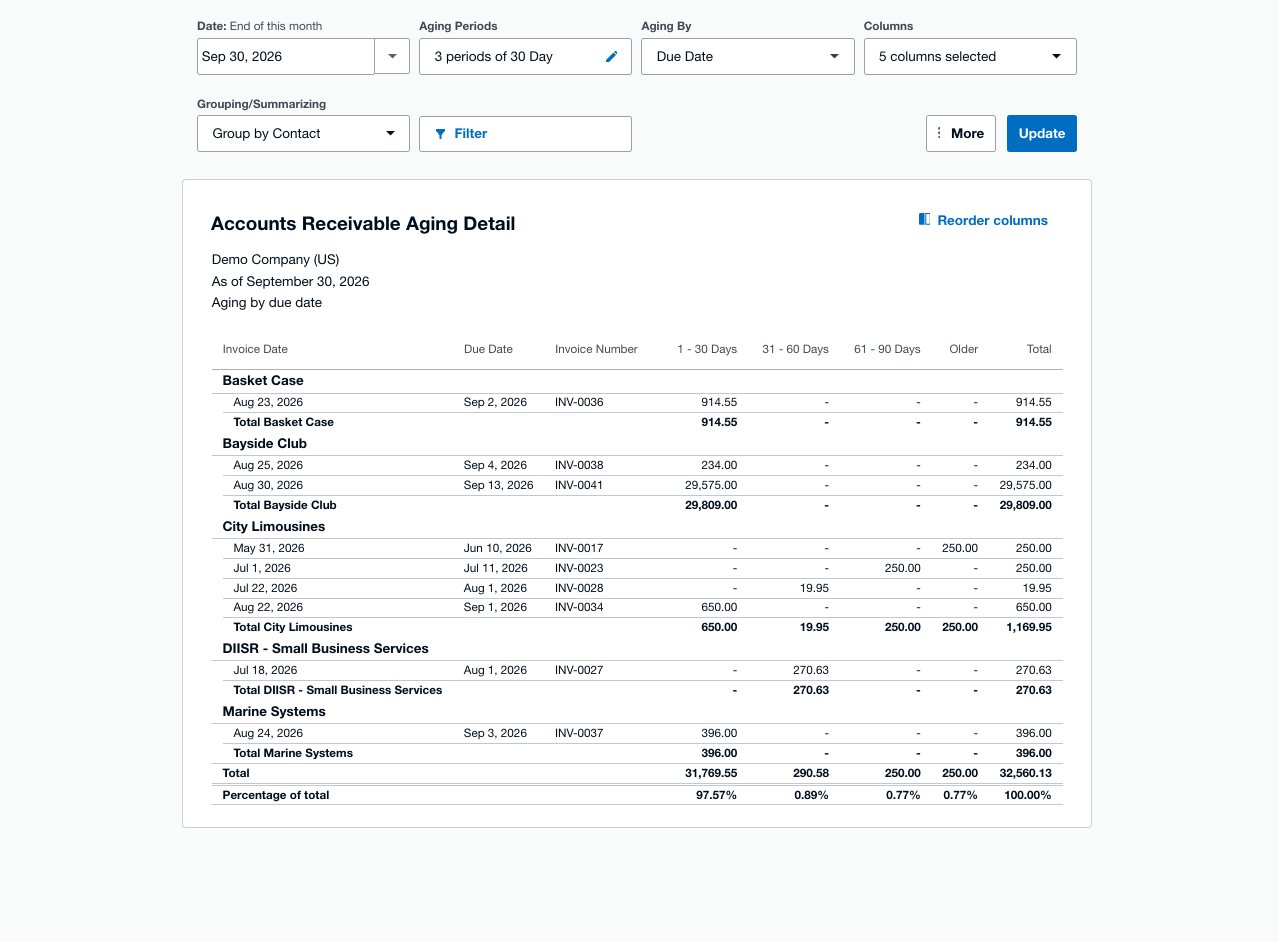
We set up and run the receivables side of your Xero file: accurate invoicing, automated reminder sequences that go out under your name, clean cash application, and reporting that shows you exactly where the money is. The follow-up becomes a system instead of something you have to remember to do.
The problem
Most businesses that get paid late aren't dealing with customers who won't pay. They're dealing with customers who haven't been asked clearly, consistently, or early enough: because asking is uncomfortable, and uncomfortable tasks get postponed.
That postponement compounds. An invoice that goes unchased for three weeks is significantly harder to collect than one followed up on day three, not because the customer changed but because the urgency evaporated on both sides. Meanwhile the business owner carries the whole thing personally: they know who's late, they think about it on Sunday night, and they decide each time whether this is the week they finally say something.
Xero has real tools for this. What's usually missing is the structure around them: who gets chased, when, in what tone, and what happens when the ladder runs out.
Work finishes on the 3rd, the invoice goes out on the 20th, terms start then. You've financed the customer for seventeen days without deciding to.
Some customers get chased weekly, others never, based on who feels most awkward to contact. Customers learn quickly which category they're in.
The invoice says net 30. Everyone pays net 55. Nobody has ever mentioned it, so net 55 is now the real term.
New customers get terms because they asked. The first sign of a problem is an invoice that ages past 90 days.
Payments arrive without reference, part-paid or bundled across invoices. The aged report becomes fiction and you chase people who already paid.
An invoice sits at 120 days not because the customer won't pay, but because of an unresolved query nobody escalated.
Nothing damages a customer relationship faster than a demanding reminder for money already sent. It signals that your records are unreliable, and it hands the customer a reason to disengage from the whole process. This is why cash application discipline matters as much as chasing discipline, and why every reminder we send is checked against current payment status first, rather than against a report pulled last Tuesday.
What we run
Getting paid is a sequence, not an event. We take responsibility for the whole of it: from how quickly the invoice leaves to how cleanly the payment lands back against it.
The cheapest cash flow improvement available to most businesses is invoicing sooner. Terms don't start when the work finishes: they start when the invoice arrives, so every day of delay is a day of free credit you didn't intend to extend.
We set up and run the invoicing cycle in Xero: repeating invoices for recurring revenue, quote-to-invoice conversion so nothing gets re-keyed, and a defined billing cadence so invoices leave on a schedule rather than when someone remembers. Accuracy matters just as much, a wrong PO number or a missing line reference is the most common reason an invoice quietly sits in a customer's system for a month.
Friction at the point of payment costs more than most businesses realize. If paying you requires finding bank details in an email, logging into a portal, and typing a reference correctly, some proportion of customers will simply do it later.
We configure online payment options directly on your Xero invoices so paying is a click, and we make sure your terms are stated where they can be seen and applied consistently. Where late fees or early-payment discounts fit your business, we set the rules and apply them evenly: the fairness is the point, because selectively enforced terms aren't terms.
Reminders work when they're consistent and calibrated. We build a ladder: what goes out before the due date, what goes out after, how the tone shifts, and at what point a human picks up the phone instead of sending another email.
Different customers get different ladders. A ten-year client on a small balance doesn't need the sequence a new customer at 60 days overdue does. Reminders go out under your name and in your voice, so from the customer's side this reads as your business being organized rather than as an outsourced collections operation.
We review the aging every month and treat it as a working document rather than a report. Each aged balance gets a reason: disputed, awaiting a PO, customer in difficulty, or simply not chased hard enough. Reasons are what let you act; a total is just a number.
Alongside that, we track the measures that tell you whether the process is working: days sales outstanding, the aging profile over time, and which customers consistently pay beyond terms. When a customer's behavior shifts, you find out from a trend rather than from a bad month.
Money arriving is not the end of the process. It has to be matched to the right invoice, or your aged report misleads you and your reminders start going to people who already paid.
We apply receipts daily against invoices in Xero, handle the messy cases: part payments, bundled payments across several invoices, overpayments, payments with no reference, and reconcile the receivables ledger every month. Unidentified receipts get chased down rather than parked in suspense, because a suspense balance is just a problem with a later date on it.
The signature
Most businesses have no sequence at all: just an increasingly irritated email whenever someone notices. A configured ladder replaces that with steps that are proportionate, expected, and sent automatically, so nothing depends on how anyone feels that day or whether they had time.
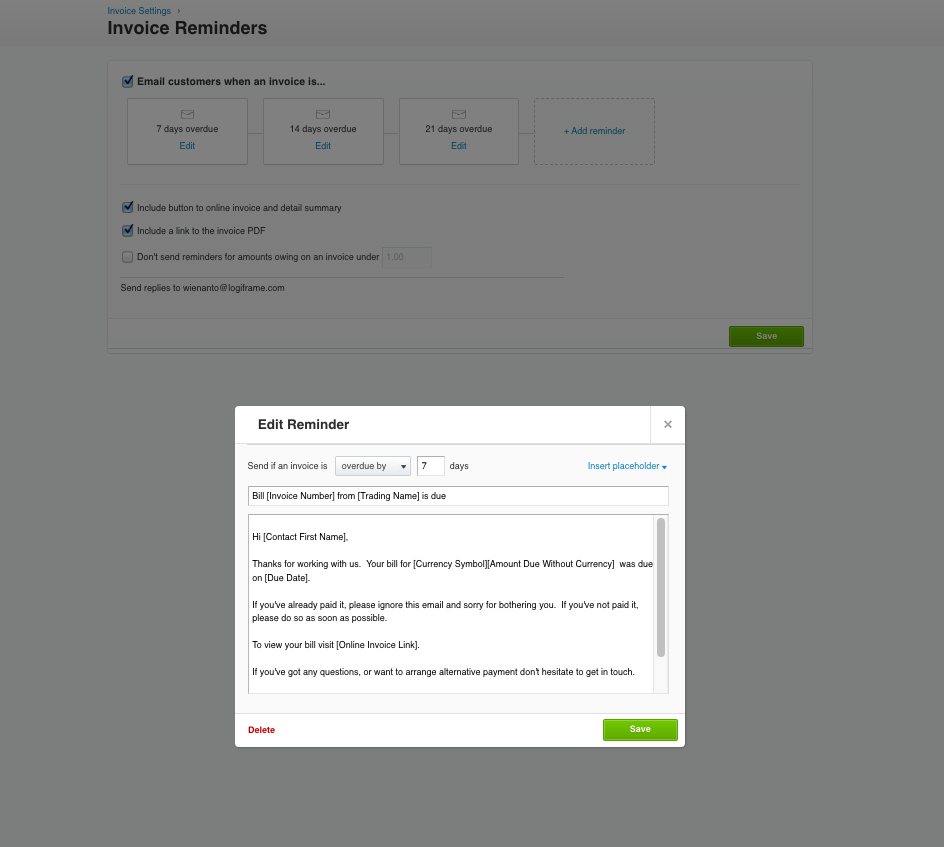
This is a representative structure for a customer on net 30 terms, built in Xero’s invoice reminder settings. Yours will differ by segment, and that is the point: a long-standing client and a new account carrying a large balance should not be on the same sequence. We configure it, monitor whether it is working, and tell you when it is not.
| Timing | Action | Tone | Purpose |
|---|---|---|---|
| Day 0 | Invoice issued with pay-now option | Neutral | Start the clock immediately; remove friction from paying |
| Day 23 | Pre-due courtesy reminder | Helpful | Catches invoices lost in the customer's own AP process: the highest-value step in the ladder |
| Day 31 | Overdue notice | Matter-of-fact | Establishes that the date is real, without accusation |
| Day 38 | Second notice plus statement of account | Firmer | Removes "which invoice?" as an obstacle and shows the full position |
| Day 60 | Statement plus account status flagged to you | Formal | Puts the decision in front of you while there is still time to act |
| Day 75+ | Handed to you with the full history | Your decision | Payment plan, credit hold, phone contact or recovery. Your call, and your conversation |
The day 23 step is the one people skip. A short pre-due reminder is not chasing: it's operational courtesy, and it catches the single most common cause of late payment, an invoice that never made it into the customer's own approval queue. It costs nothing, annoys nobody, and it resolves problems before they become conversations about money.
Upstream
Almost every article about receivables is about chasing. But chasing is downstream work: you're managing a decision that was already made. The decision was extending payment terms to that customer in the first place, and it usually got made by whoever wanted to close the sale.
Terms are a loan. When you invoice net 30, you're lending the customer the value of that work, unsecured, at zero interest, on the strength of nothing more than their asking. Framed that way, most businesses realize they've never actually decided their lending policy.
A simple credit policy, sized to your business, covering who gets terms and who pays upfront, what a new customer has to provide before terms are granted, what the ceiling is on an unpaid balance before new work pauses, and who has authority to override any of it. Small businesses often resist this as too corporate, but a one-page policy consistently applied prevents the situation where the largest bad debt comes from the customer everybody liked.
Where it fits, we can also set up credit monitoring so a deteriorating customer surfaces as a signal rather than as a surprise. The decision to extend, hold or withdraw credit is always yours. We provide the information and apply the policy you set.
On the receivables side, the risk isn't usually a fake supplier: it's the combination of one person applying cash and that same person being able to issue credit notes or write off balances. That pairing allows a shortfall to be concealed indefinitely by adjusting the record rather than the reality.
We apply cash and prepare credit notes and write-offs, but we don't approve them. Approval sits with you. It's the same principle as our payables work: whoever records a transaction shouldn't also be the one who authorizes it.
The stack
Xero handles invoicing, online payments and basic reminders natively. For many businesses that's genuinely enough. Where the ladder gets more sophisticated, or the customer base gets large enough that segmentation matters, a dedicated receivables app earns its cost.
| Layer | Tools we commonly use | When you need it |
|---|---|---|
| Core ledger | Xero invoicing and invoice reminders | Always: every engagement runs on Xero as the source of truth |
| Payment acceptance | Stripe, GoCardless, Square | Always worth enabling. Card, ACH and direct debit options on the invoice remove the most common excuse for delay |
| Reminder automation | Chaser, Paidnice, and similar Xero-native AR apps | When you need reminders from your own domain, multi-channel chasing, or different ladders for different customer segments |
| Late fees and interest | Dedicated AR apps with fee automation | When your terms include late fees and you want them applied consistently rather than case by case |
| Credit risk | Credit monitoring within AR platforms | When you extend meaningful terms and want deterioration flagged before it becomes a write-off |
Xero's native invoice reminders are free, quick to switch on, and adequate for a lot of small businesses. They send automatic follow-ups on overdue invoices without any additional subscription. If you have a modest customer base who mostly pay near terms, start here: there's no reason to buy software to solve a problem you don't have.
The limits show up as you grow. Native reminders are email-only, capped at a small number of stages, and: the one that matters most, they send from Xero's domain rather than your own, which makes them read as automated. A dedicated app fixes those specific things: reminders from your address with your signature, SMS and phone alongside email, unlimited segmented workflows, automated late fees, and a customer payment portal.
Our rule of thumb: if your ladder needs more than three steps, more than one channel, or more than one version for different customer types, you've outgrown the native tool. Below that, you haven't. We'll tell you which side of the line you're on before recommending anything.
We don't resell software. App subscriptions are billed to you directly by the vendor at their own rates. Our recommendations are based on fit, not margin, and if Xero alone covers what you need, we'll say so.
In practice
Receivables improve through consistency rather than intensity. This is the cadence most of our clients settle into within the first two months.
Receipts matched against open invoices, exceptions investigated. The aged report is accurate every morning, not just at month end.
Reminders go out on schedule, calls made where the ladder calls for them, replies and disputes routed to you same-day.
Every aged balance gets a reason and an action. DSO and aging profile reported with commentary on what moved and why.
Credit limits, terms by customer and ladder segmentation reviewed against how customers have actually behaved.
We start by establishing what's really outstanding, which is rarely what the aged report says. That means reconciling the receivables ledger, clearing unapplied receipts, identifying which aged balances are genuinely collectible versus disputed versus already written off in everything but name, and agreeing the tone and structure of your ladder before a single reminder goes out under your name.
Expect the aged balance to move in the first month, sometimes significantly: old items that were never going to be collected get surfaced for your decision. That's uncomfortable but useful, a receivables number you can trust is worth more than a larger one you can't.
Scope
Being clear about what we don't do is part of doing the rest properly. These aren't gaps we're working on: they're deliberate boundaries.
We are accountants and Xero specialists, not a collections function. We configure the reminder sequence, keep the ledger accurate so every reminder is correct, and show you exactly who is late and by how much. We do not telephone your customers, negotiate payment, or contact them outside the automated sequence that goes out under your name. Those conversations belong to you, because they are relationship decisions and because collections is a regulated activity with its own licensing and conduct requirements. When an account needs real recovery, you have the full history in one place, which makes instructing a licensed agency or your attorney a handover rather than a restart.
We help you build a credit policy, we provide the information behind it, and we apply it consistently. Whether to extend terms to a particular customer, hold new work, agree a payment plan or write off a balance is a commercial decision that stays with you.
We don't issue demand letters that assert legal consequences, and we don't advise on the enforceability of your terms. That's work for an attorney, and getting it wrong exposes you rather than us.
Logiframe US does not prepare or file tax returns and does not run payroll. We keep receivables recorded accurately so your CPA works from clean books, and we'll coordinate directly with them, but tax positions, filings and advice sit with your tax professional.
Your Xero bookkeeping package already records invoices, tracks what is owed and produces your aging. Setting up and maintaining the reminder sequence is part of running that file properly, not a separate purchase. It is not sold on its own, because running receivables against books someone else maintains would make us accountable for a number we cannot control.
Standard aging and receivables reports come with the package. If you need something built to your own question, for example an AR report reconciled against work actually performed, or revenue by job against what has been billed and collected, that is analysis rather than bookkeeping. We are glad to build it and produce it each month, and we quote it separately so you can see what it costs.
Receivables scope moves with invoice volume, customer count and entity count, the same factors that size the bookkeeping package itself. See our bookkeeping packages for what is included.
Questions
An outsourced AR service runs the invoice-to-cash cycle on your behalf: issuing invoices accurately and on schedule, enabling online payment options, configuring and maintaining structured reminder sequences that send under your name, reviewing aged receivables, applying incoming cash against the right invoices, and reconciling the receivables ledger. We do not telephone your customers or pursue collections. The commercial decisions, who gets credit terms, whether to agree a payment plan, when to write off a balance: stay with the business owner. The provider supplies the process and the discipline.
Xero's native reminders are free, quick to configure, and adequate for many small businesses with a modest customer base who mostly pay near terms. Their limits are specific: they're email-only, capped at a small number of stages, and they send from Xero's domain rather than your own address, which makes them read as automated.
A dedicated Xero-native AR app addresses exactly those gaps: reminders sent from your own email address with your branding, multi-channel chasing including SMS and phone, unlimited segmented workflows for different customer types, automated late fees, and a customer payment portal. A reasonable threshold. If your reminder ladder needs more than three steps, more than one channel, or different versions for different customer segments, the native tool is no longer sufficient.
Not unless you want them to. Reminders go out under your business name, from your domain, with your branding and in the tone you've approved. Where calls form part of the ladder, we can introduce ourselves either as your accounts team or as your outsourced finance partner, depending on your preference. Most clients choose the former for routine chasing, because customers respond to it as normal business communication rather than as escalation.
Four levers, roughly in order of impact for most small businesses. First, invoice faster: terms don't start until the invoice arrives, so billing delay is pure added DSO. Second, add pre-due-date reminders, which catch invoices lost inside the customer's own approval process before they're ever late. Third, remove friction from paying by enabling card, ACH or direct debit directly on the invoice. Fourth, apply your terms consistently across all customers, since selectively enforced terms teach customers that the due date is negotiable.
Chasing harder after the fact is the least effective lever, which is why it's the one most businesses reach for first.
The one sent a few days before the due date. It isn't chasing, so it carries no relationship cost, and it catches the most common cause of late payment: an invoice that never made it into the customer's own approval queue. By the time an invoice is overdue, you're solving a problem that a short courtesy note a week earlier would have prevented entirely.
Yes, and the ladder should include it. Email works until it stops working: once a customer has ignored two written reminders, a third rarely changes anything. A call surfaces what email cannot, an unresolved dispute, a missing PO, a change of contact, or genuine financial difficulty that might be better addressed with a payment plan than with escalation. In our standard ladder, a call comes around two weeks after the due date.
No. We provide credit control as part of your accounting function: configured reminder sequences and statements that go out under your name, with aged receivables reviewed and flagged to you. We do not contact your customers by phone. Third-party debt collection is a separately regulated activity with its own licensing and conduct requirements. When an account reaches the point of formal recovery, we hand it to you with the complete communication history so you can instruct a licensed collection agency or your attorney with everything already documented.
Unidentified receipts are matched by amount, timing and customer history against open invoices; where that isn't conclusive we contact the customer to confirm what the payment relates to rather than guessing. Nothing is left parked in suspense from one month to the next. Getting this right is what makes the aged report trustworthy, and prevents the most damaging AR error, which is sending a demanding reminder to a customer who has already paid.
We help you build a credit policy covering who gets terms versus upfront payment, what a new customer must provide before terms are granted, the balance ceiling before new work pauses, and who can override it. Where it's warranted, we can also set up credit monitoring so a deteriorating customer surfaces early. The decision to extend, hold or withdraw credit is always yours: we supply the information and apply the policy you set.
Yes. Non-profit receivables often look different from commercial AR: grant installments, pledges, membership dues and program fees rather than straightforward trade invoices, each with its own timing and recognition treatment. We configure Xero so restricted and unrestricted income is coded correctly at the point of invoicing, and we tailor the follow-up approach, since chasing a foundation on a scheduled grant payment is a different conversation from chasing a late commercial customer.
AR management is priced as an add-on to a Xero bookkeeping package, scoped on invoice volume, active customer count, number of entities and how much chasing your customer base actually requires. It isn't sold standalone, because managing receivables properly requires ownership of the ledger and the reconciliation as well. We'll quote after a short review of your current aging and process.
Related
A 30-minute review of your receivables: how quickly you invoice, what's genuinely collectible, where the ladder breaks down, and what it would take to bring DSO down.