
Services
Monthly bookkeeping run entirely in Xero — closed, reviewed and proven every period by the team that does the work.
Bookkeeping packages

Bookkeeping & accounting
The whole function rather than data entry: reconciliation, payables and receivables, the month-end close, and statements your CPA can work from at year end. Three stages, real figures, and a plain account of what moves the price.
The scope
The term is old-fashioned and it is still the clearest one available. A full-charge bookkeeper runs the whole accounting cycle rather than one part of it, and closes the period at the end.
The distinction matters because a lot of what gets sold as bookkeeping is really transaction coding. Someone categorises the bank feed, the queue empties, and nobody establishes whether the balance sheet is true. That produces a file that looks maintained and cannot answer a question.
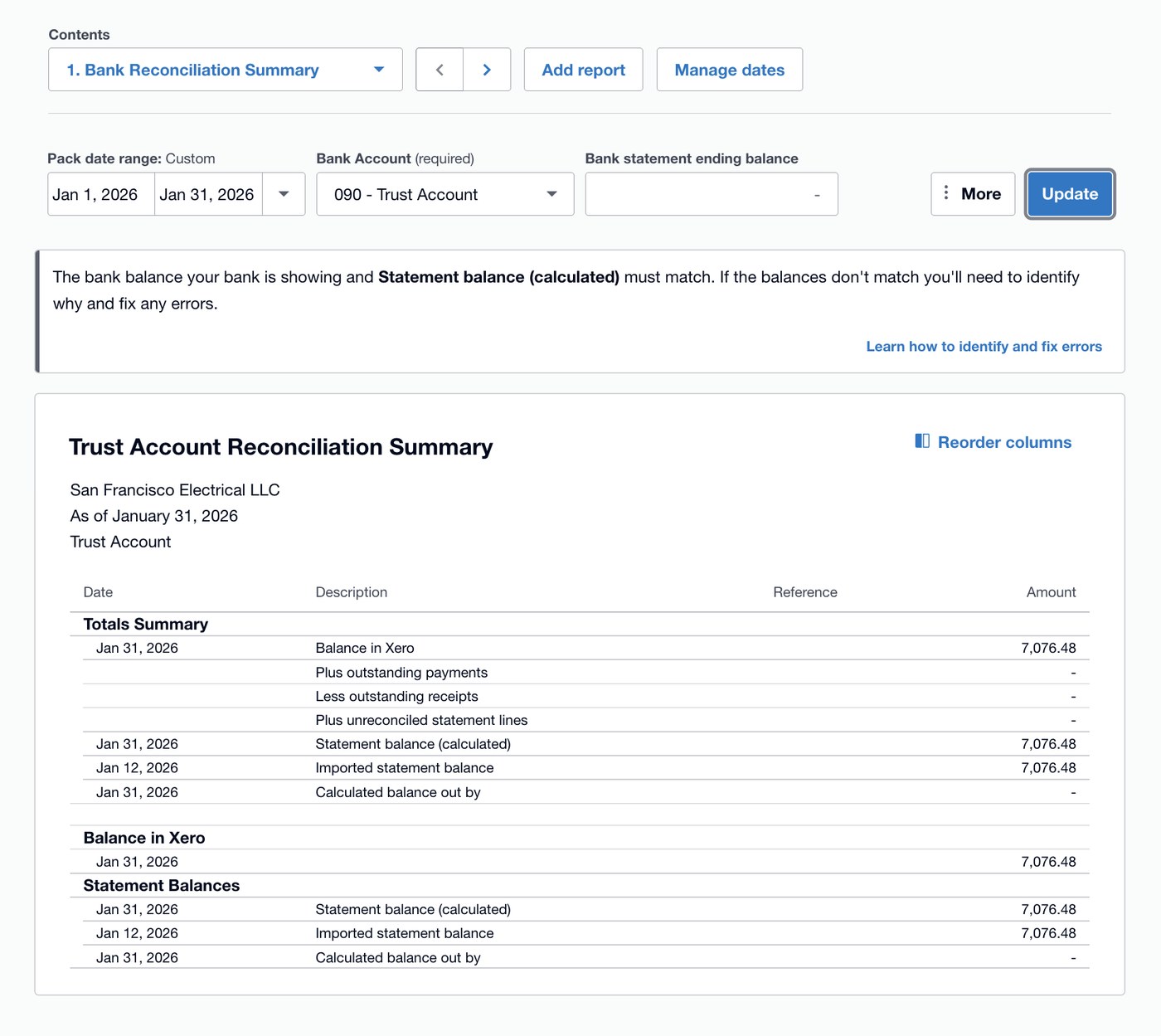
What this is not: we do not prepare or file tax returns, and we do not run payroll. Those sit with your CPA and your payroll provider. What we do is give both of them a file that does not need fixing first.
The Xero subscription is billed in your name and you pay Xero directly. What the engagement covers is everything that turns that subscription into a working system: the chart of accounts built for how your business actually runs, bank feeds connected and monitored, approval workflows configured to your thresholds, the apps around Xero integrated and tested, and reporting set up to answer your questions rather than the defaults.
Xero also ships new capability continuously, and most subscribers never turn any of it on. Part of what you are paying for is someone tracking what is new, deciding whether it is worth enabling on your file, and configuring it when it is. You are paying Xero more each year either way. Whether you get anything for it depends on whether someone is watching.
A ledger you own, configured properly and kept that way, closed every month by people who know your file.
Packages
Most engagements start with onboarding, then run on Monthly or Weekly. Every figure below is a floor rather than a fixed quote, for reasons set out in the next section.

Stage one
From $2,500 one-time project
Clean, accurate books and a proper transition before the ongoing rhythm starts.
Sized forNew clients whose file needs establishing, correcting or bringing current before month-to-month work begins.
What moves the priceMore months to clean, more than one entity, or reconstruction rather than tidying.
Stage two
From $399 / month
Accurate books closed each month, tax-ready records year-round.
Sized forOne entity, around 50 transactions a month, closed monthly.
What moves the priceMore entities, higher transaction volume, or more accounts to reconcile. Each entity is scoped and priced on its own.
Stage two, faster
From $599 / month
For businesses that cannot wait until month-end to know where they stand.
Sized forThe same scope as Monthly: one entity, around 50 transactions a month, reconciled weekly instead of monthly.
What moves the priceThe same drivers as Monthly. Client trust and IOLTA reconciliation is supported where you need it.
Wondering how this differs from the add-ons below? Every package records payables and receivables so your ledger and your aging reports are right. The add-ons run the cycle that produces them. There is a line-by-line comparison further down.
Before you commit to onboarding: the 32-point health check is $750 flat and tells you the file's actual condition in writing. If you engage us for ongoing bookkeeping within sixty days, the $750 is credited in full against onboarding. There is also a free 30-minute file review if you want a faster read. See what the check covers.
Honest pricing
Published figures are the floor, not a fixed quote. Anyone who quotes a bookkeeping engagement without seeing the file is either guessing or planning to revise it later.
Four things actually move the number, and none of them is your revenue:
| Driver | Why it matters |
|---|---|
| Transaction volume | The single largest driver. Fifty transactions a month and five hundred are different jobs, regardless of what the business turns over. |
| Account count | Every bank account, card, loan and payment processor is another reconciliation and another place a difference can hide. |
| Entity count | Each entity is a separate set of books, scoped and priced on its own. Intercompany balances add work that a single entity never has. |
| Structural complexity | Inventory, deferred revenue, restricted funds, job costing, trust accounting or multi-channel sales all change what a close involves. |
A short working session is usually enough for us to size an engagement accurately. Where the file's condition is genuinely unclear, the health check settles it before either of us commits to a number.
Each entity is scoped and priced as its own engagement at whichever stage fits it. A three-entity business might run all three on Monthly, or mix cadences depending on what each entity actually needs. We do not push multi-entity businesses into a special tier as a matter of course.
Fees go up over time, for two reasons.
The first is inflation, which applies to us the way it applies to you. The second is growth: as your volume, accounts, entities and complexity increase, so does the work, and the engagement is repriced to match. That second one also runs downward, when a business simplifies or brings something back in-house.
So we agree a review schedule at the start rather than raising it once something has already changed. The first review is around twelve months in, and roughly every two years after. A review is a look at the whole engagement rather than a scheduled increase, and it can end with the number unchanged.
Add-ons
Every package already records AR and AP. These add-ons are for when you want the cycle run rather than recorded.
Invoices out accurately and on time, reminder ladders configured and running under your own name and branding, payment options enabled, cash applied against the right invoices, and aged receivables reported so you always know who owes what and for how long.
What this is not: we are not a collections function. We do not phone your customers, negotiate terms or chase on your behalf. Those conversations are yours, and we make sure you have the accurate picture before you have them.
Bills captured and coded, routed through an approval workflow that matches your thresholds, duplicates caught before they are paid, supplier bank detail changes verified, payment runs prepared against your cash cycle, and supplier statements reconciled.
What this is not: we never release payment. The run is prepared and presented, and a person at your business approves and sends it. We do not hold signing authority on any account.
This is the question we get asked most, so here it is line by line. The left column is what you already get. The right column is what another $100 a month buys.
| What happens | Included in every package | With the add-on |
|---|---|---|
| Payables | ||
| A bill arrives | Entered and coded, appears in aged payables | Captured automatically through Hubdoc or Dext rather than forwarded around by email |
| Approval | However you handle it today | Routed to the right approver by amount, supplier or department, timestamped against the bill |
| Duplicate invoices | Found at month-end, if at all | Caught before payment |
| Supplier bank detail changes | Not monitored | Verified before any payment is prepared |
| Deciding what to pay | You work it out from the aging report | Payment run prepared against your cash cycle, ready for your release |
| Supplier statements | Not reconciled | Reconciled, so missing and duplicated bills surface |
| Receivables | ||
| Raising invoices | Recorded once you raise them | Billing cadence run so invoices leave on schedule, repeating invoices and quote conversion configured |
| Chasing overdue | Nothing sends automatically | Reminder ladder configured and maintained, sending under your own name and branding |
| Getting paid | Whatever payment method you already offer | Pay-now options enabled on invoices, terms stated and applied consistently |
| Applying cash | Clean one-to-one matches, as part of reconciliation | Partial payments, one receipt covering several invoices, short payments and deductions |
| Aged receivables report | Yes, every month | Yes, plus a view of where each account sits in the ladder |
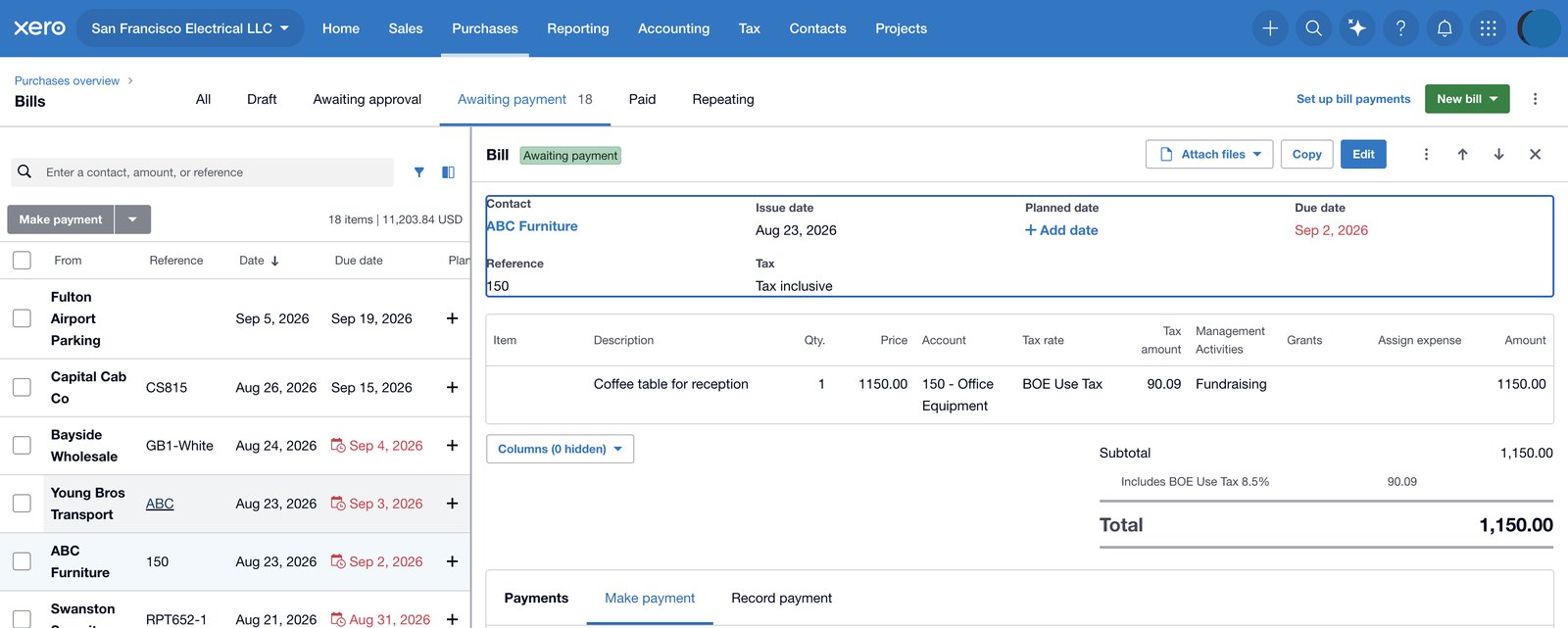
Add-on only, and deliberately so. Neither can be bought without a bookkeeping package. Managing receivables or payables against books someone else maintains would make us accountable for a number we cannot control, so we do not offer it that way. Scoping follows invoice volume, bill volume, supplier and customer count, entity count and approval complexity.
The close
A closed month is not a month in which someone finished coding. It is a month that has been proven and then locked, so the numbers stop moving after anyone has read them.
That distinction becomes expensive the first time someone outside the business reads your accounts. A lender, a board, an investor or an acquirer will ask when the period closed and whether it has changed since. A file where prior periods keep shifting is a file nobody can rely on.
One
Every bank, card and processor account reconciled to a real statement, with outstanding items listed individually rather than assumed.
Two
Payables, receivables, payroll and any clearing accounts agreed to their subledgers. A clearing account that never clears is the classic warning sign.
Three
Every line explainable with a schedule behind it. Accruals and prepayments posted so the month reflects what actually happened in it.
Four
Lock date set, statements produced and delivered by the agreed working day. After that the period is closed and stays closed.
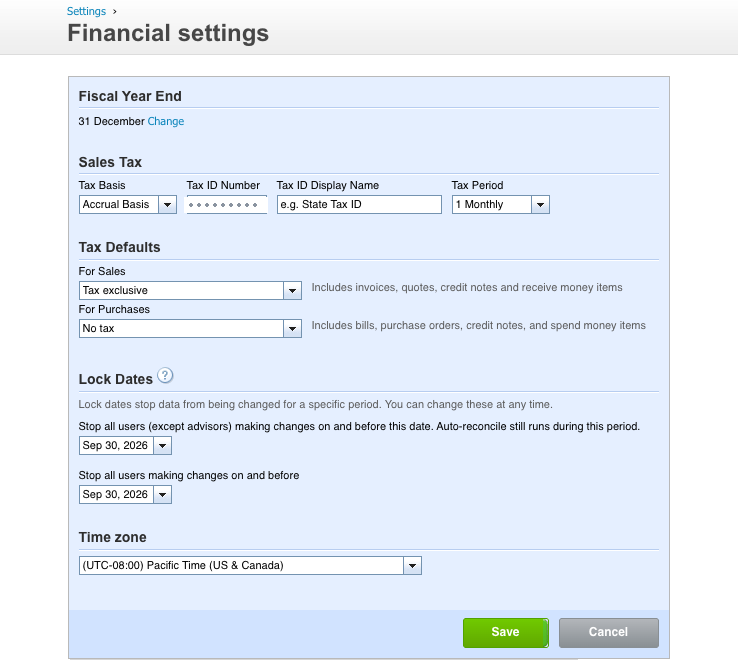
The close is short when the month was not saved up. A file reconciled continuously closes in days. A file touched once a month closes in weeks, because everything found at the end has to be investigated with the context already gone.
For the mechanics of running this yourself in Xero, the handbook covers it in detail. Month-end close in Xero is the guide, and this page is the service.
Deliverables
Agreed during onboarding and delivered by a stated working day, so it arrives on a schedule rather than on request.
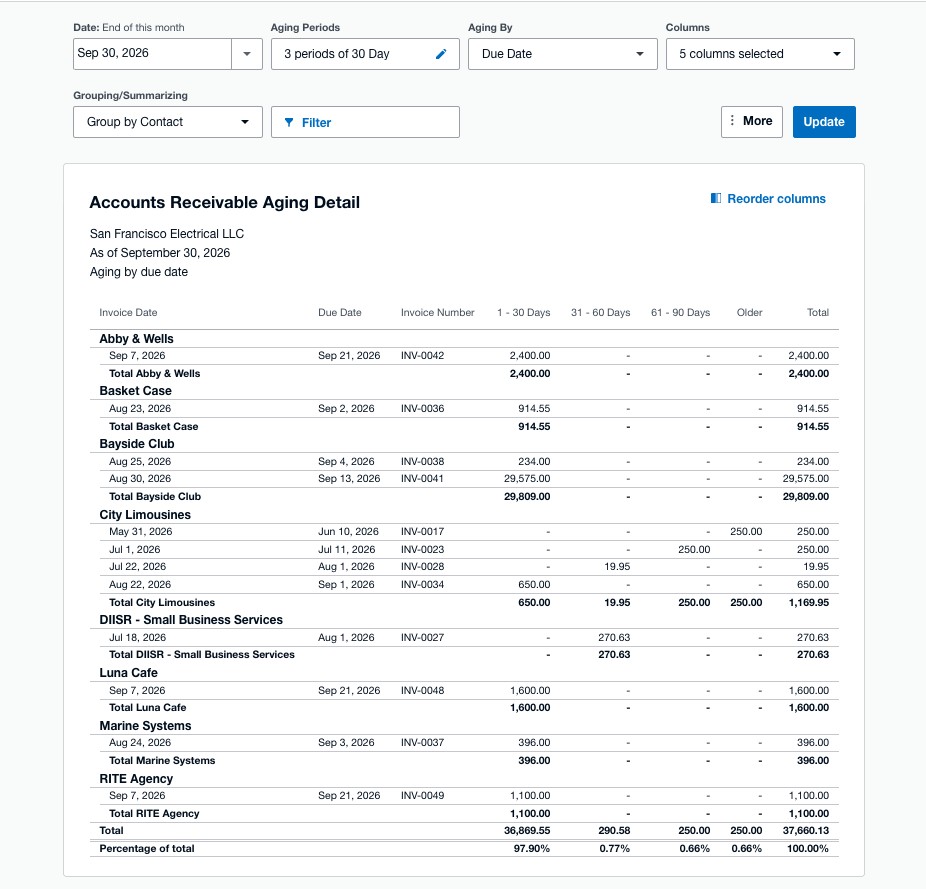
Standard statements and aging reports come with the package. If you need something built to your own definitions, such as a recurring report reconciling receivables against work actually performed, that is analysis rather than bookkeeping. We are glad to build it and produce it each month, and we quote it separately so you can see what it costs.
Boundaries
The second column is longer than most firms would print. We would rather be a clear no on six things than a vague maybe on everything.
Questions
Yes, for two reasons.
The first is inflation. Wages rise every year, for us as they do for you, and a fee held flat for years is a fee with a quietly shrinking service behind it. Those adjustments are small, infrequent, and flagged before they apply.
The second is your business. As volume, accounts, entities and complexity grow, the work grows with them, and the engagement is repriced to match what it now takes. This one runs both ways: when something comes back in-house or the business simplifies, the number comes down.
Either way you hear it at a scheduled review, never on an invoice.
Next
However far behind they are. We will tell you what it takes to get them current, and what it costs to keep them that way.