
Services
Monthly bookkeeping run entirely in Xero — closed, reviewed and proven every period by the team that does the work.
Bookkeeping packages

Who we serve
Most firms we meet already run Clio well. Matters, time, billing and client trust ledgers are in reasonable order. What tends to slip is the firm’s own accounting and the monthly step that ties the two together, which is also the first thing anyone reviewing your trust account will ask to see. This page is about that step: what it should produce, what it catches, and where the routine transactions go wrong.
The structure
A firm holding client funds keeps two things at once: its own books, which work like any professional services business, and a record of money that belongs to other people. The second one has rules the first does not, and they are worth stating plainly because most of the work follows from them.
Your state bar is the authority and the detail varies, but the shape is consistent nearly everywhere and follows the model rule on safekeeping property.
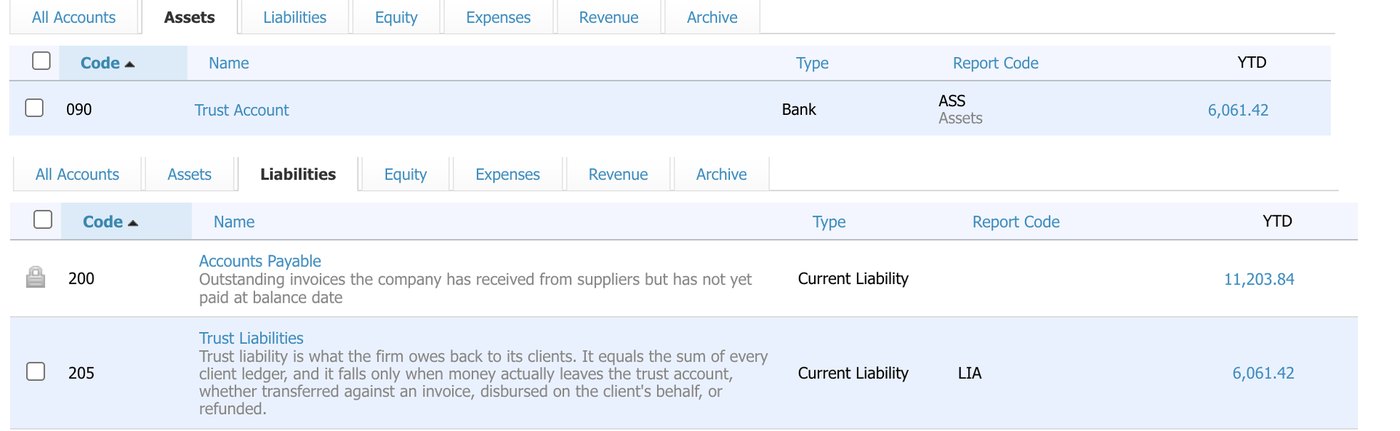
What good looks like in the ledger: a trust bank account and a trust liability account that are always equal and opposite, never used for anything else, and never netted against operating. If your chart of accounts has one and not the other, that is the first thing to fix, and it takes an afternoon.
The control
This is the procedure at the centre of trust work. It is not difficult, it takes under an hour in a well kept file, and it is the single most useful hour a firm spends each month.
Three figures have to agree as at the same date:
One
The adjusted bank balance. Reconciled properly, with outstanding checks and deposits listed individually rather than assumed.
Two
The control account in your general ledger, representing everything owed back to clients in total.
Three
The sum of every individual client and matter balance, printed as a list, with the list itself retained.
The order is what makes it quick. Reconcile the bank first, so you are comparing against a number that is already right. Post the period’s trust journals into the ledger next, so the liability account is current. Then run the client ledger report and compare all three. If they agree, you are finished. If they do not, the difference is almost always in step two, because the bank and the practice management system are both recording actual events while the journal is the step a person performs.
Two habits make the difference between a firm that finds this easy and one that dreads it. Scan the client ledger list for any negative balance before you look at the total, because that is the finding a reviewer looks for first and the total will not reveal it. And keep the output: the three figures, the list, the date and who performed it. A reconciliation you cannot produce a year later did not fully happen.
A useful monthly test: a trust account can agree to the bank and to the ledger in total while one client sits overdrawn, covered by another client’s funds. Only the itemised list shows that. If your current process produces a total and not a list, adding the list is the highest value change available to you.
The systems
Most firms we work with run Clio, and it is genuinely good at what it does. Understanding the boundary matters, because the gap between the two systems is where trust errors live.
Clio holds the matter. Time, billing, disbursements, client and matter trust ledgers, and the trust reports your state bar expects to see. That is the source of truth for what each client is owed.
The general ledger holds the firm. Profit and loss, balance sheet, payroll, partner draws, and the trust bank and trust liability accounts that have to reconcile back to Clio.
The integration syncs contacts, time and expense activities, bills, credit notes, interest and Clio Payments transactions. What it does not do is move trust activity into your accounting file on its own. Trust receipts and disbursements are recorded against the trust bank and trust liability accounts by journal, and Clio’s own trust ledger report is what you reconcile against. Clio documents this itself.
Two systems, one of which is authoritative for client balances and the other for the firm’s financial position, joined by a step that somebody has to perform every month. When a firm tells us its trust does not reconcile, the cause is almost never Clio and almost never the accounting file. It is that the journal between them was skipped, estimated, or posted to the wrong period.
Clio launched a built-in general ledger inside Clio Manage in February 2026. For a solo practitioner who wants one system and one subscription, that is a reasonable answer and it removes the seam described above entirely. For firms with payroll running elsewhere, a CPA who works in a particular platform, multiple entities, or reporting needs beyond the basics, the established arrangement of Clio alongside a full accounting platform still holds.
Our honest position: it is a real option and worth evaluating, and it is also a product in its first year. If you are already running Clio with Xero or QuickBooks Online and the reconciliation is working, changing the architecture is not urgent. If you are choosing now, it deserves a look.
The common causes
Almost every trust problem we see started as an ordinary transaction that landed in the wrong place. Each of these has a straightforward fix, and most of them are one-time setup rather than ongoing effort.
Past compliance
Trust compliance keeps you safe. It does not tell you which work is worth doing, and the same systems already hold what would. A firm that is fully compliant can still have no idea which of its work is worth doing.
Clio holds most of the raw material for this. The work is getting it into a shape a partner can read on a monthly basis, alongside financial statements that agree with it.
Boundaries
Sharper than usual here, because in this area the boundary protects you as much as us.
Questions
Next
Not the trust total. The list, client by client, agreed to the bank and to the ledger on the same date. Tell us what you run and we will tell you what your reconciliation is actually proving.
BOOK A FREE 30 - MINUTE CALL See the 32-point check