15 min read
The Business Model of Coal Mining Contractors
In the coal industry, headlines are dominated by coal prices. When prices surge, optimism follows. When prices fall, budgets tighten and projects are...
Logiframe is an Equal Opportunity Employer.
All qualified applicants will receive consideration for employment without regard to race, color, age, religion, sex, sexual orientation, gender identity / expression, national origin, protected veteran status, or any other characteristic protected under federal, state or local law, where applicable, and those with criminal histories will be considered in a manner consistent with applicable state and local laws.
Managed Services
Streamline your finance, tax, and payroll with reliable managed services built for scale.
NetSuite
Unlock enterprise-grade ERP to automate operations, gain insights, and scale your business smarter.
Xero
Empower your growing business with easy, cloud-based accounting and powerful Xero add-ons.
HubSpot
Turn your website, marketing, and CRM into one powerful growth engine with HubSpot solutions built for scale.
Featured Blog
Software akuntansi Xero sudah menggunakan sistem cloud computing yang artinya Anda tidak perlu menginstalnya lagi di PC (Personal Computer). Anda dapat mengakses laporan keuangan perusahaan atau cash flow secara real time asalkan terhubung dengan internet.

By Industries
By Functions
Featured Blog

Dashbor NetSuite adalah salah satu bagian terpenting NetSuite. Memiliki dasbord yang terkonfigurasi dengan benar sangat penting bagi setiap karyawan untuk dapat dengan cepat menavigasi ke data yang mereka perlukan untuk melihat dan mengawasi tren penting.

By Functions
Discover accounting and technology solutions
designed to streamline operations, boost efficiency,
and empower growth for your small business.

Xero Accounting Software
Xero is a cloud-based accounting software that simplifies
invoicing, bank reconciliation, payroll, and expense tracking,
helping businesses manage finances efficiently and in real-time.
Featured Blog

In a remarkable achievement, Xero has been named one of the World’s Top 250 Fintech Companies for 2024 by CNBC. This recognition underscores Xero’s unwavering commitment to innovation, technology, and providing world-class cloud accounting solutions for businesses worldwide.
-1.webp?width=287&height=191&name=Xero%20Recognized%20Among%20the%20Worlds%20Top%20250%20Fintech%20Companies%20in%202024%20(feature%20blog)-1.webp)
Learn about our people, values, and more
About Us Overview →
Our Commitment
Featured Blog
The award underscores Logiframe's position as a trusted partner in leveraging NetSuite solution to drive business success and operational efficiency. This achievement reflects Logiframe's dedication to staying at the forefront of technology and providing outstanding solutions in the dynamic landscape of ERP.
.webp?width=409&height=289&name=Untitled%20design%20(11).webp)
Knowledge
Comparison
Event
Featured Blog
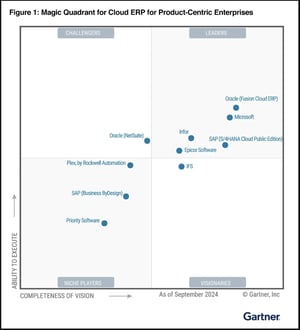
In Cloud ERP for Wholesale and Distribution, NetSuite is the strong Challenger in Gartner's Magic Quadrant for Product-Centric Enterprises. Yes, large ERP vendors dominate the market with Oracle Fusion Cloud ERP, SAP S/4HANA Cloud, and Microsoft Dynamics 365, but NetSuite provides the ideal solution to mid-market wholesale and distribution businesses by delivering robust functionality without excessive costs or complexity.

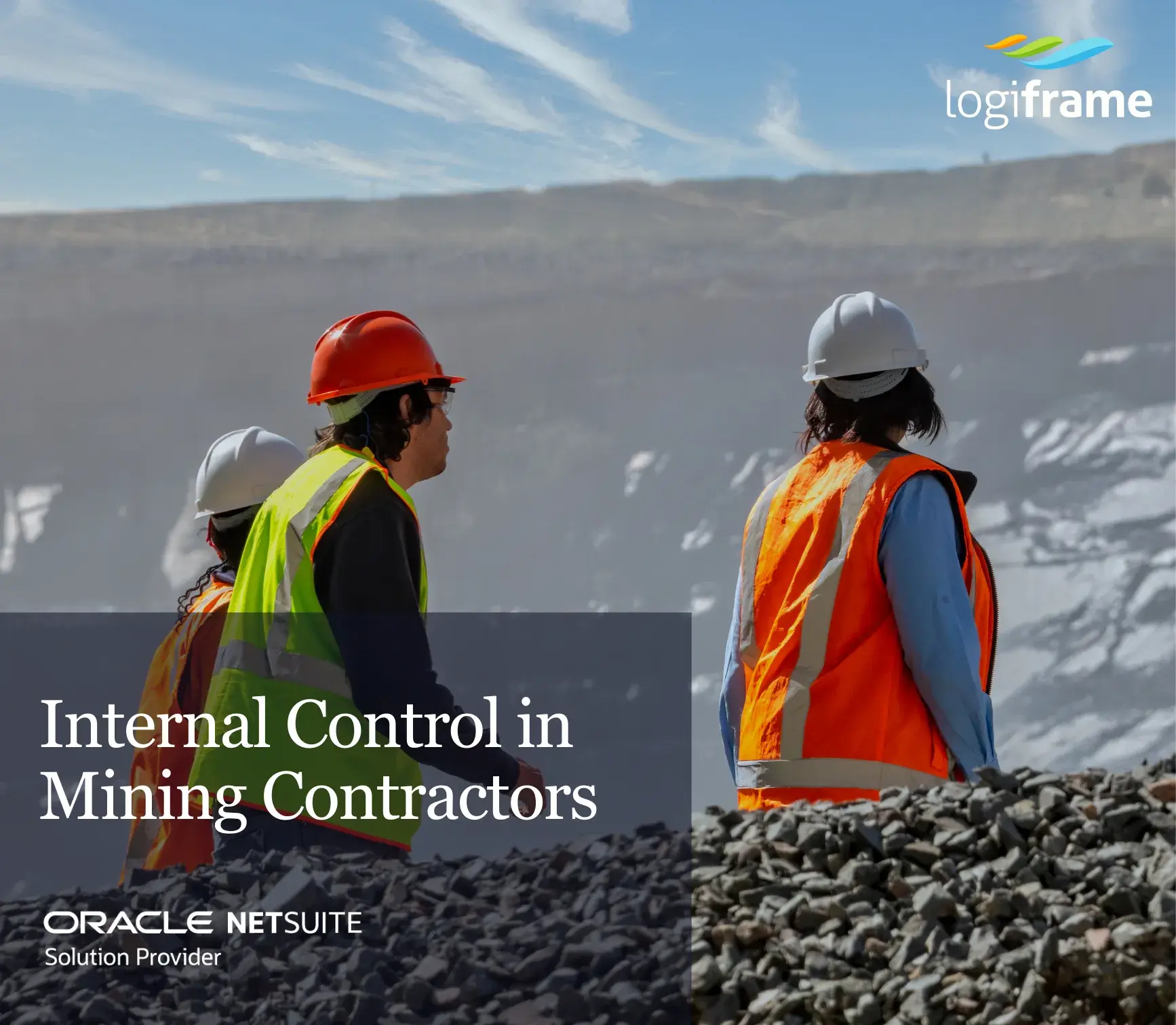
For coal mining contractors, internal control is often discussed in uncomfortable terms. It is seen as a necessary safeguard, but also as a potential obstacle to speed, flexibility, and production continuity. In an industry where operations run twenty-four hours a day, decisions are made on site, and costs accumulate by the hour, any perception of bureaucracy is quickly resisted.
This creates a false trade-off: control versus productivity.
In reality, the most successful mining contractors demonstrate that strong internal control does not slow operations. When designed properly, it does the opposite. It reduces friction, eliminates uncertainty, protects margins, and allows management to scale operations with confidence.
This article examines why internal control is uniquely challenging in mining contractor businesses, where control failures typically occur, how fraud and leakage take root in high-pressure operational environments, and how disciplined contractors use modern ERP systems to strengthen governance without disrupting the business.
Table of Contents:
1. Why Mining Contractors Are Structurally Exposed to Control Risk
2. The Most Common Internal Control Failures
3. Why Traditional Controls Do Not Work in Mining Operations
4. Internal Control as an Enabler, Not a Barrier
5. The Role of Integrated Systems in Control Design
6. Approval Workflows That Match Operational Reality
7. Segregation of Duties Without Excessive Headcount
8. Audit Trails That Support, Not Punish, Operations
9. Vendor Master Control as a First Line of Defense
10. From Detective to Preventive Control
11. Behavioral Impact of Embedded Controls
12. Scaling Operations Without Scaling Risk
13. Final Thoughts
Mining contractors operate in one of the most complex control environments of any industry.
They manage:
At the same time, they face intense pressure to maintain uptime and meet production targets. Site managers are rewarded for speed and continuity, not for administrative perfection.
This combination creates structural exposure to control risk. Weaknesses do not usually arise from malicious intent at the top. They emerge from process gaps, role overlaps, and incentive misalignment at operational level.
While every organization is different, internal control failures in mining contractors tend to cluster around a few recurring themes.
Procurement Leakage
Procurement is one of the largest and most vulnerable processes in mining operations. High volumes, urgent requirements, and operational pressure often lead to shortcuts.
Typical issues include:
Over time, these practices normalize. Leakage is not always obvious fraud. It often appears as slightly inflated prices, unnecessary purchases, or inefficient sourcing that quietly erodes margins.
Ghost Vendors and Inflated Invoices
In decentralized environments, vendor master data is a frequent point of failure.
Common problems include:
Because procurement, receiving, and payment processes are often fragmented across systems and locations, these issues can persist for long periods before detection.
Cash Versus Operational Control Tension
Mining contractors frequently face a tension between financial discipline and operational urgency.
Operations teams prioritize:
Finance teams prioritize:
When controls are poorly designed, operations perceive finance as an obstacle. As a result, workarounds emerge. Controls are bypassed, documentation is completed after the fact, and accountability becomes blurred.
This is not a cultural failure. It is a design failure.
Many contractors respond to control failures by adding more rules, approvals, and audits. These measures often fail because they do not address how mining operations actually function.
Traditional controls tend to be:
They slow processes without improving insight. Over time, they are bypassed or ignored, creating a false sense of security.
Effective internal control in mining must be embedded in daily workflows, not imposed after the fact.
Also Read: How ERP Transformed a Wholesale Distribution Business
The purpose of internal control is not to eliminate risk. In mining, risk is unavoidable. The purpose is to ensure that risk is visible, owned, and managed deliberately.
Well-designed controls:
When controls are aligned with how work is actually done, they speed up decision-making by removing uncertainty and rework.
Modern mining contractors increasingly recognize that internal control is as much a systems problem as a policy problem.
Fragmented systems create fragmented control. When procurement, inventory, finance, and approvals live in separate tools, no single function has full visibility. Gaps appear naturally.
An integrated ERP platform such as NetSuite allows controls to be designed into workflows rather than layered on top of them.
One of the most effective control mechanisms is a well-designed approval workflow.
In mining operations, approvals must be:
Fast
Context-aware
Proportionate to risk
NetSuite allows approval workflows to be configured based on:
Transaction value
Type of expense
Site or project
Budget availability
Routine operational purchases can flow quickly with minimal friction, while higher-risk or out-of-budget transactions trigger additional scrutiny. This reduces blanket bureaucracy and focuses control where it matters.
Also Read: NetSuite Multi-Entity Consolidation | Streamline Group Operations
Segregation of duties is a foundational control principle, but it is difficult to implement in remote sites with lean teams.
NetSuite enforces segregation of duties at the system level by separating:
Vendor creation and payment approval
Purchase requisition and receipt confirmation
Journal entry creation and posting
These controls do not require additional staff. They rely on role-based access and system-enforced rules, reducing reliance on individual discipline.
Audit trails are often perceived negatively because they are associated with fault-finding after the fact. In reality, a strong audit trail protects both the organization and its employees.
NetSuite automatically records:
This transparency discourages misconduct, but it also protects honest employees by providing objective evidence of decisions made under operational pressure.
When audit trails are built into normal workflows, compliance becomes a byproduct of doing the job, not an additional task.
Vendor master data is one of the most critical control points in any mining contractor organization.
With NetSuite, vendor creation and modification can be:
This significantly reduces the risk of ghost vendors and unauthorized changes, while still allowing operations to onboard legitimate suppliers efficiently when required.
Also Read: ERP Implementation | Seamless Deployment for Business Efficiency
Traditional internal control relies heavily on detective measures such as audits and reconciliations. These are important, but they occur after losses have already happened.
Integrated systems shift the balance toward preventive control:
This reduces reliance on periodic audits and strengthens day-to-day governance.
As mining contractors grow, control challenges multiply. More sites, more vendors, more transactions, and more people increase the surface area for risk.
Manual controls do not scale. Integrated systems do.
By standardizing workflows and controls across sites, contractors can expand operations without proportionally increasing risk exposure or administrative burden.
Internal control in mining contractors is not about slowing people down or second-guessing operational decisions. It is about creating a structure in which speed and discipline coexist.
Fraud, leakage, and control failures rarely result from a lack of rules. They result from systems and processes that do not reflect operational reality.
By embedding approval workflows, segregation of duties, and audit trails into daily work through platforms such as NetSuite, mining contractors can prevent losses before they occur, protect their people, and maintain the operational agility their business demands.
Strong internal control is not a constraint on performance. It is a prerequisite for sustainable scale.
15 min read
In the coal industry, headlines are dominated by coal prices. When prices surge, optimism follows. When prices fall, budgets tighten and projects are...
15 min read
How Mining Contractors Lose Millions Without Knowing It and How Discipline Restores Control For coal mining contractors, fuel is rarely the headline...
15 min read
Turning Mining Production Data into Financial Insight In coal mining contractor businesses, vast amounts of data are generated every day. Bank cubic...