15 min read
The Business Model of Coal Mining Contractors
In the coal industry, headlines are dominated by coal prices. When prices surge, optimism follows. When prices fall, budgets tighten and projects are...
Logiframe is an Equal Opportunity Employer.
All qualified applicants will receive consideration for employment without regard to race, color, age, religion, sex, sexual orientation, gender identity / expression, national origin, protected veteran status, or any other characteristic protected under federal, state or local law, where applicable, and those with criminal histories will be considered in a manner consistent with applicable state and local laws.
Managed Services
Streamline your finance, tax, and payroll with reliable managed services built for scale.
NetSuite
Unlock enterprise-grade ERP to automate operations, gain insights, and scale your business smarter.
Xero
Empower your growing business with easy, cloud-based accounting and powerful Xero add-ons.
HubSpot
Turn your website, marketing, and CRM into one powerful growth engine with HubSpot solutions built for scale.
Featured Blog
Software akuntansi Xero sudah menggunakan sistem cloud computing yang artinya Anda tidak perlu menginstalnya lagi di PC (Personal Computer). Anda dapat mengakses laporan keuangan perusahaan atau cash flow secara real time asalkan terhubung dengan internet.

By Industries
By Functions
Featured Blog

Dashbor NetSuite adalah salah satu bagian terpenting NetSuite. Memiliki dasbord yang terkonfigurasi dengan benar sangat penting bagi setiap karyawan untuk dapat dengan cepat menavigasi ke data yang mereka perlukan untuk melihat dan mengawasi tren penting.

By Functions
Discover accounting and technology solutions
designed to streamline operations, boost efficiency,
and empower growth for your small business.

Xero Accounting Software
Xero is a cloud-based accounting software that simplifies
invoicing, bank reconciliation, payroll, and expense tracking,
helping businesses manage finances efficiently and in real-time.
Featured Blog

In a remarkable achievement, Xero has been named one of the World’s Top 250 Fintech Companies for 2024 by CNBC. This recognition underscores Xero’s unwavering commitment to innovation, technology, and providing world-class cloud accounting solutions for businesses worldwide.
-1.webp?width=287&height=191&name=Xero%20Recognized%20Among%20the%20Worlds%20Top%20250%20Fintech%20Companies%20in%202024%20(feature%20blog)-1.webp)
Learn about our people, values, and more
About Us Overview →
Our Commitment
Featured Blog
The award underscores Logiframe's position as a trusted partner in leveraging NetSuite solution to drive business success and operational efficiency. This achievement reflects Logiframe's dedication to staying at the forefront of technology and providing outstanding solutions in the dynamic landscape of ERP.
.webp?width=409&height=289&name=Untitled%20design%20(11).webp)
Knowledge
Comparison
Event
Featured Blog
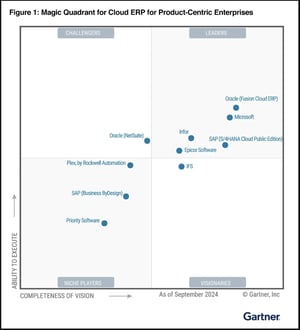
In Cloud ERP for Wholesale and Distribution, NetSuite is the strong Challenger in Gartner's Magic Quadrant for Product-Centric Enterprises. Yes, large ERP vendors dominate the market with Oracle Fusion Cloud ERP, SAP S/4HANA Cloud, and Microsoft Dynamics 365, but NetSuite provides the ideal solution to mid-market wholesale and distribution businesses by delivering robust functionality without excessive costs or complexity.

5 min read
Wienanto Tanuwidjaja
:
Jan 16, 2026 6:13:47 PM
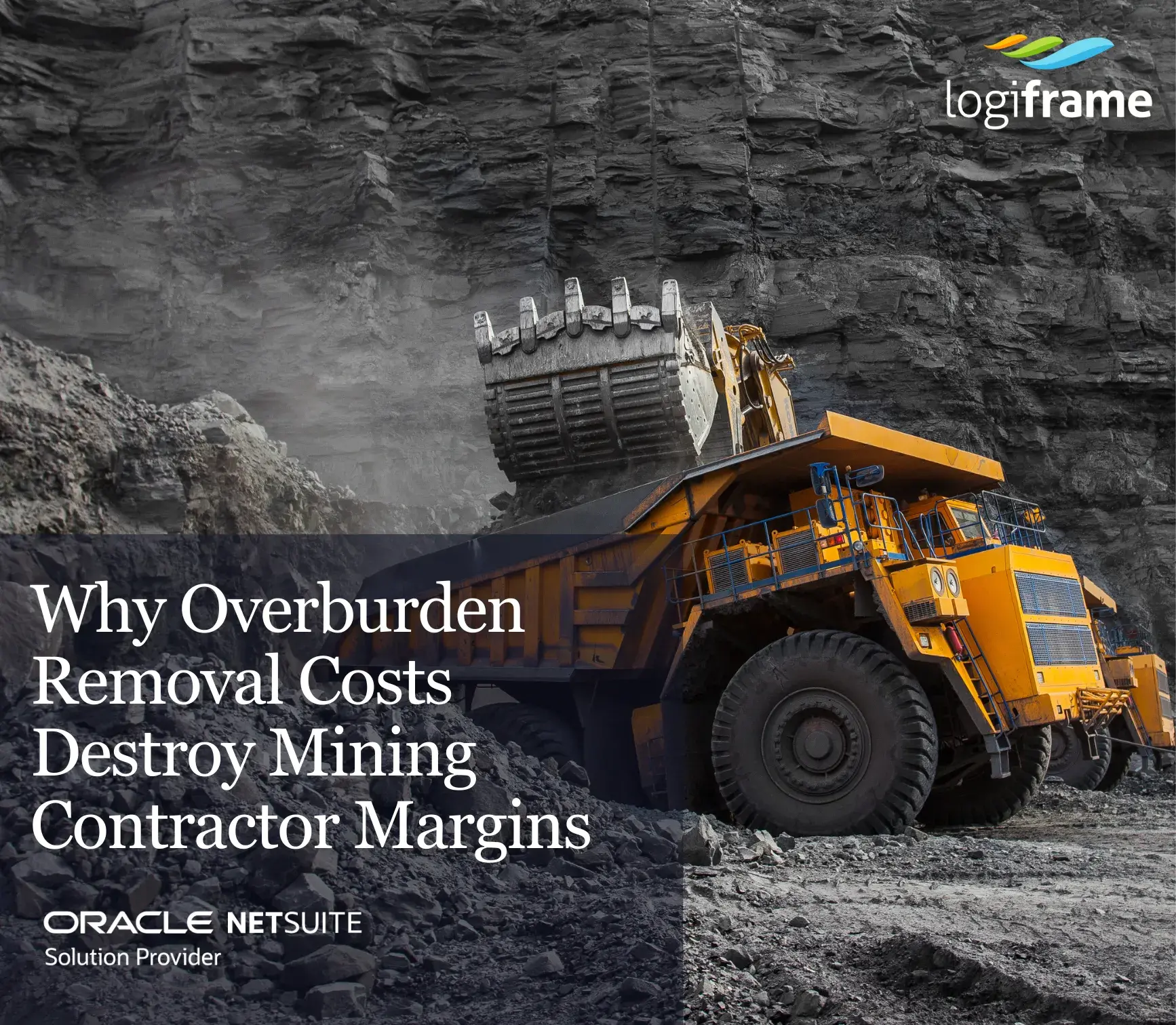
For coal mining contractors, overburden removal (OB) is not just one line item among many. It is the https://logiframe.com/netsuite. In most open-pit coal mines, overburden removal accounts for 50–70% of total mining cost, making it the single largest determinant of whether a contract generates profit or quietly erodes margins.
Yet OB cost overruns rarely announce themselves clearly. Contractors often meet production targets, achieve planned BCM volumes, and maintain operational continuity, while profitability deteriorates in the background. By the time financial results confirm the problem, the damage is already embedded in thousands or millions of BCMs moved at suboptimal economics.
This article explains why overburden removal costs are uniquely destructive to mining contractor margins, where the real cost drivers hide, why traditional reporting consistently fails to surface problems early, and how disciplined contractors use integrated ERP systems to regain control at pit, fleet, and contract level.
Table of Contents:
1. Overburden Removal: A High-Volume, Low-Tolerance Activity
2. The Production Trap: When Volume Masks Inefficiency
3. Three OB Cost Drivers That Quietly Destroy Margins
4. Why Traditional Reporting Fails OB Cost Control
5. Operational Discipline as the Only Sustainable Defense
6. How NetSuite ERP Enables OB Cost Control
7. The Strategic Payoff Beyond Cost Control
8. Final Thoughts
Overburden removal is deceptively simple in concept. Material is excavated, hauled, and dumped to expose coal seams. Contractors are typically paid on a unit-rate basis per BCM, often under long-term contracts with tight pricing.
This creates a narrow margin structure governed by a simple formula:
Margin per BCM = Contracted Rate – Actual Cost per BCM
Because volumes are enormous, even small deviations in cost per BCM have a disproportionate impact on profitability. A cost overrun of a few thousand rupiah per BCM can translate into millions of dollars in annual margin erosion for large-scale operations.
The risk is not that OB costs are high. The risk is that they are high, variable, and often poorly understood in real time.
One of the most persistent myths in mining operations is that strong production performance equates to strong financial performance. In reality, production volume can conceal inefficiency for extended periods.
A contractor may report:
OB targets achieved or exceeded
Fleet availability within acceptable ranges
Minimal operational disruptions
Yet still experience:
The reason is simple. Volume amplifies inefficiency. When cost control is weak, higher production does not fix the problem; it accelerates it.
Also Read: Why NetSuite? | The #1 Cloud ERP for Scalable Business Growth
Strip ratio is foundational to OB economics. Mine plans define expected strip ratios based on geological models and sequencing assumptions. In practice, strip ratio is rarely static.
Daily operations are affected by:
Geological variability
Rainfall and pit accessibility
Haul distance changes
Resequencing due to operational constraints
When actual strip ratios diverge from plan, more material must be moved for the same coal output. Equipment hours increase, fuel consumption rises, and maintenance intensity grows, all without a corresponding increase in revenue.
The issue is not strip ratio volatility itself, which is unavoidable in open-pit mining. The issue is financial blind spots. Many contractors do not see the cost impact of strip ratio changes until period-end reporting, long after corrective action would have been effective.
Fuel is typically the second-largest cost component after equipment ownership and depreciation. Despite this, fuel is often managed operationally, not financially.
Common challenges include:
Each of these factors erodes cost per BCM incrementally. Individually, they may appear manageable. Collectively, they are destructive.
Equipment utilization compounds the problem. Underutilized equipment still incurs depreciation, financing costs, and maintenance overhead. When utilization drops without corresponding fleet adjustment, costs rise faster than management expects.
Without integrated visibility linking equipment hours, fuel usage, and BCM output, management sees symptoms rather than root causes
Also Read: ERP Implementation | Seamless Deployment for Business Efficiency
Idle time is one of the least visible but most expensive OB cost drivers.
Idle time arises from:
Poor truck-excavator matching
Dispatch inefficiencies
Weather interruptions
Maintenance bottlenecks
Shift transition delays
Operational teams may track idle time as a performance metric, but its financial impact is rarely assigned clear ownership. Idle hours are absorbed into averages, normalized over large volumes, and seldom challenged.
The result is structural inefficiency. Idle time becomes an accepted part of operations, even though it represents paid labor, consumed fuel, depreciating assets, and lost productive capacity.
Most mining contractors rely on a familiar combination of site production reports, spreadsheets, and month-end financial summaries. This approach consistently fails to control OB costs for several reasons.
First, it is backward-looking. By the time costs appear in financial statements, the operation has already moved large volumes of material at suboptimal economics.
Second, it aggregates too much information. Costs are summarized by period rather than by pit, fleet, equipment class, or activity, obscuring root causes.
Third, it separates operations from finance. Operations focus on BCMs and hours, finance focuses on totals and variances, and neither sees real-time cost per BCM at the level where decisions are made.
The contractors that consistently protect margins approach overburden removal as a financial process, not just an operational one.
This requires:
Clear cost ownership at pit and fleet level
Continuous visibility into actual versus planned performance
Early detection of deviations
Rapid, data-driven corrective action
Achieving this level of discipline requires more than better spreadsheets. It requires an integrated management platform.
NetSuite does not replace mine planning, fleet management, or dispatch systems. Instead, it serves as the financial and operational backbone that converts activity data into management insight.
Overburden removal activities can be structured as projects or cost objects by pit, mining block, or contract. Planned BCMs, budgeted costs, and productivity assumptions are compared continuously against actual performance.
This enables management to see, during the month rather than after close, which pits or contracts are eroding margins and why.
Rather than pooling costs, NetSuite allocates fuel, labor, maintenance, spare parts, and depreciation directly to equipment units and fleets.
This creates true visibility into:
Heavy equipment is no longer viewed simply as a fixed asset, but as a measurable economic unit.
NetSuite supports continuous variance analysis between planned and actual performance. Deviations in cost per BCM, utilization, or productivity are visible while corrective action is still possible.
Management can adjust fleet size, redeploy equipment, revise shift patterns, or revisit operational assumptions before losses compound.
Because procurement, inventory, accounts payable, and project costing are integrated, NetSuite connects OB inefficiency directly to cash flow impact.
Management can see how rising OB costs translate into working capital pressure, why cash burn accelerates, and which operational decisions are driving liquidity risk.
In a capital-intensive business, this visibility is critical.
Also Read: Oracle NetSuite: Scalable ERP Solutions to Power Your Business
When OB costs are controlled systematically, contractors gain advantages beyond margin protection.
They can bid more accurately, defend pricing during contract renegotiations, benchmark performance across sites, and respond faster to operational disruptions. Most importantly, management regains confidence that emerging problems will be visible early, not discovered after the fact.
Overburden removal does not destroy mining contractor margins suddenly. It destroys them quietly, incrementally, and at scale.
The difference between contractors that survive downturns and those that struggle is not fleet size or contract volume. It is an operational discipline supported by real-time financial insight.
By treating overburden removal as a financially managed process and using integrated systems such as NetSuite to enforce visibility and accountability, contractors can move from reactive firefighting to proactive control..webp?width=4320&height=2430&name=Why%20Overburden%20Removal%20Costs%20Destroy%20Mining%20Contractor%20Margins%20(2).webp)

15 min read
In the coal industry, headlines are dominated by coal prices. When prices surge, optimism follows. When prices fall, budgets tighten and projects are...
15 min read
Turning Mining Production Data into Financial Insight In coal mining contractor businesses, vast amounts of data are generated every day. Bank cubic...
15 min read
How Mining Contractors Lose Millions Without Knowing It and How Discipline Restores Control For coal mining contractors, fuel is rarely the headline...