


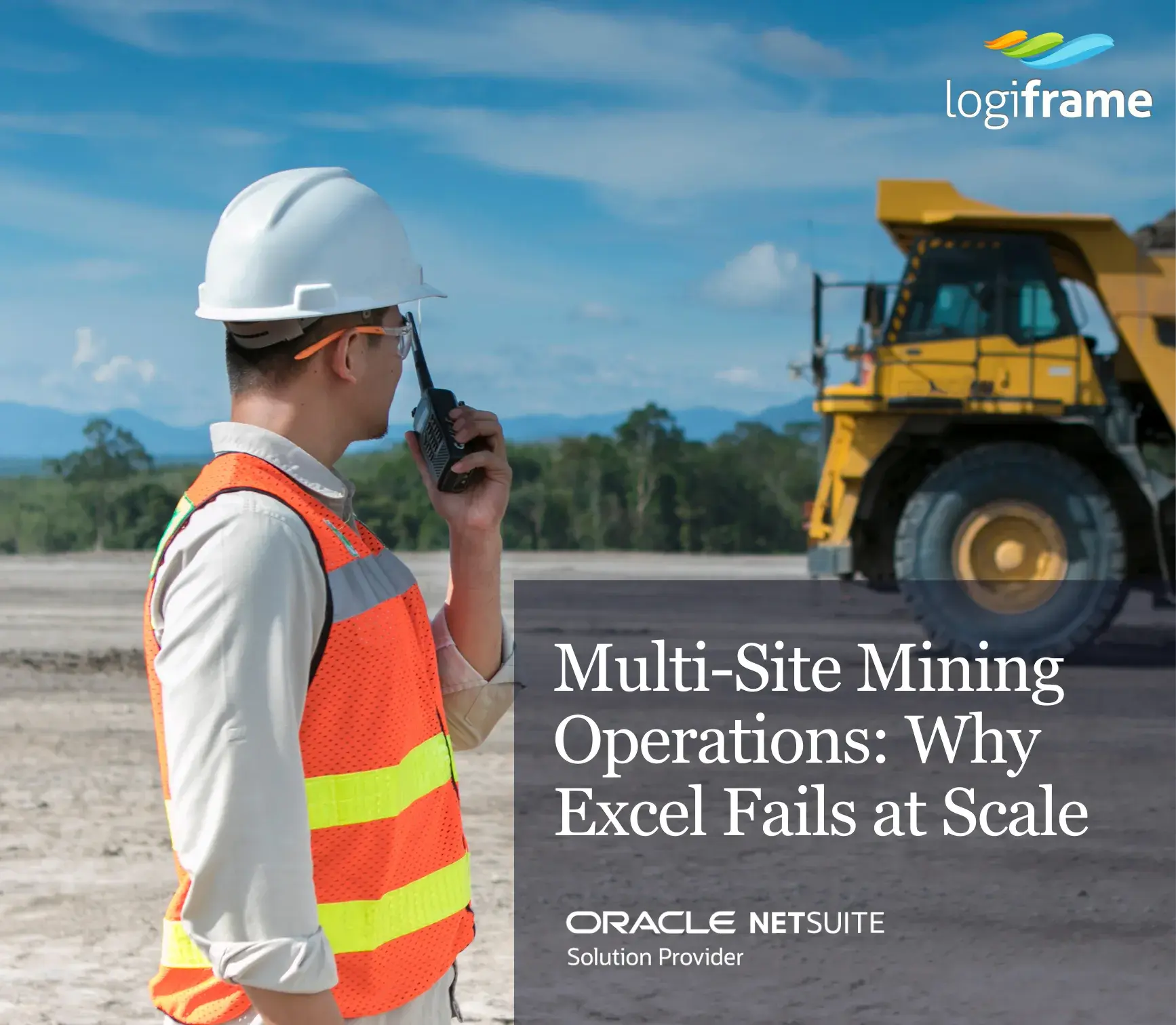
And How Integrated Systems Restore Control Across Pits, Fleets, and Contracts
As coal mining contractors grow, complexity does not increase gradually. It accelerates.
A single-site operation can often be managed through close supervision, informal coordination, and spreadsheets that track production, cost, and performance. But once a contractor operates multiple pits, multiple fleets, and multiple contracts simultaneously, the management challenge changes fundamentally.
What once worked through effort and experience begins to break down. Excel files multiply. Numbers diverge. Head office and site teams argue over whose data is correct. Financial results arrive late and raise more questions than answers.
This is the point at which many mining contractors realize that their real constraint is no longer equipment, labor, or contracts. It is scalability of control.
This article examines why spreadsheet-based management fails in multi-site mining contractor organizations, where fragmentation becomes dangerous, how inter-site and intercompany costing distorts decision-making, and how integrated ERP systems such as NetSuite enable contractors to scale operations without losing visibility or discipline.
Table of Contents:
1. The Nature of Multi-Site Mining Complexity
2. Why Excel Works at One Site and Fails at Five
3. The Hidden Risk of Fragmented Reporting
4. Intercompany and Inter-Site Transactions: The Silent Distorter
5. Why Head Office and Site Reporting Drift Apart
6. Scalability Requires Structural Change, Not More Effort
7. How NetSuite Enables Scalable Control
8. Operational and Behavioral Impact
9. Strategic Benefits of Scalable Systems
10. Final Thoughts
The Nature of Multi-Site Mining Complexity
Mining contractors do not scale like manufacturing plants or retail networks. Each site operates as a semi-independent ecosystem with its own characteristics.
Across multiple sites, contractors must manage:
- Different pits with different strip ratios and geology
- Multiple fleets with varying equipment mix and utilization
- Separate contracts with unique pricing, KPIs, and penalties
- Remote operations with limited direct supervision
- Site-specific procurement and logistics constraints
At the same time, head office must:
- Consolidate financial performance
- Allocate shared costs fairly
- Manage cash flow and working capital
- Ensure consistent governance and reporting
This dual reality creates tension between local operational autonomy and central financial control.
Why Excel Works at One Site and Fails at Five
Excel is powerful, flexible, and familiar. For a single site, it can be an effective management tool. Problems emerge when scale increases.
Spreadsheet Proliferation
In multi-site environments, spreadsheets tend to multiply:
- Each site maintains its own production files
- Finance builds separate costing models
- Head office creates consolidation spreadsheets
- Adjustments are tracked offline
Very quickly, there is no single version of the truth. Every report depends on which file was last updated.
Manual Consolidation Becomes a Bottleneck
When data from multiple sites must be consolidated manually:
- Definitions differ across locations
- Timing differences distort results
- Adjustments are layered on top of adjustments
Consolidation becomes a process of negotiation rather than analysis. Management discussions shift from performance to reconciliation
Inter-Site Costing Becomes Arbitrary
Multi-site contractors often share:
- Equipment
- Maintenance resources
- Engineering teams
- Procurement contracts
- Head office overhead
In spreadsheet-based systems, allocating these shared costs is often approximate. Allocation drivers are simplified or inconsistent, leading to distorted site-level profitability.
As a result:
- Profitable sites may appear underperforming
- Loss-making sites may appear acceptable
- Management decisions are based on incomplete economics
Also Read: NetSuite for Mining Operations
The Hidden Risk of Fragmented Reporting
Fragmentation is not just inefficient. It is risky.
When head office lacks real-time visibility:
- Cost overruns are detected late
- Underperforming sites continue unchecked
- Cash flow pressure builds quietly
When sites feel disconnected from financial reporting:
- Local teams distrust head office numbers
- Accountability weakens
- Operational discipline erodes
Over time, fragmentation undermines both performance and governance.
Intercompany and Inter-Site Transactions: The Silent Distorter
As contractors grow, legal and organizational structures often become more complex. Different sites may operate under different entities for licensing, tax, or contractual reasons.
This introduces:
- Intercompany equipment charges
- Shared service recharges
- Cross-site inventory movements
- Intercompany revenue and cost recognition
In spreadsheet environments, these transactions are frequently handled manually or inconsistently. Eliminations are error-prone. Intercompany balances grow unclear.
The result is group-level financials that are technically correct but operationally misleading.
Why Head Office and Site Reporting Drift Apart
One of the most damaging outcomes of scale without systems is the divergence between site-level and head office reporting.
Sites report what they see operationally:
- Production volumes
- Equipment availability
- Immediate costs
Head office reports what it sees financially:
- Allocated overhead
- Accruals and provisions
- Consolidated results
When these views are not reconciled continuously, trust erodes. Management meetings become defensive. Decisions are delayed while data is debated.
Scalability Requires Structural Change, Not More Effort
Many organizations respond to scaling challenges by:
- Hiring more accountants
- Adding more spreadsheets
- Increasing reporting frequency
These measures increase workload but do not solve the underlying problem. The issue is not effort. It is architecture.
Multi-site mining operations require systems designed to handle:
- Multiple entities
- Multiple sites and projects
- Shared resources
- Real-time consolidation
This is where integrated ERP systems become essential.
Also Read: Integrasi NetSuite dengan Software Pihak Ketiga Jadi Solusi Bisnis
How NetSuite Enables Scalable Control
NetSuite is designed for organizations that operate across multiple locations and entities. For mining contractors, this capability is not optional. It is foundational.
Multi-Entity Accounting Without Fragmentation
NetSuite allows each legal entity, site, pit, or contract to be represented within a single system.
This means:
- Each site maintains operational autonomy
- All data follows the same chart of accounts and definitions
- Head office sees consistent, comparable information
There is no need to merge spreadsheets or reconcile incompatible formats.
Site-Level Profit and Loss Visibility
With projects or sites configured as reporting units, NetSuite provides:
- Real-time site-level P&L
- Cost per BCM by location
- Margin analysis by contract
Management can see which sites are creating value and which are destroying it, without waiting for month-end consolidation.
Structured Intercompany and Inter-Site Costing
Shared resources and intercompany transactions are handled systematically:
- Equipment usage charges between sites
- Shared service allocations
- Intercompany eliminations at group level
This ensures that site-level performance reflects true economics, not accounting approximations.
Automated Consolidation at Group Level
NetSuite consolidates entities automatically:
- Currency translation
- Intercompany eliminations
- Group-level financial statements
Head office no longer spends weeks consolidating data. Instead, it focuses on interpreting results and making decisions.
Consistent Governance Across Sites
Approval workflows, budget controls, and segregation of duties can be standardized across all sites while still allowing local flexibility.
This ensures:
- Consistent internal control
- Reduced risk of leakage or fraud
- Scalable governance as the organization grows
Also Read: NetSuite Multi-Entity Consolidation | Streamline Group Operations
Operational and Behavioral Impact
When systems scale properly, behavior changes.
Site teams trust the numbers because they see the same data as head office. Head office gains confidence in site reporting because data is consistent and timely. Discussions shift from reconciliation to performance.
This alignment improves:
- Accountability
- Speed of decision-making
- Cross-site benchmarking
- Talent development
Strategic Benefits of Scalable Systems
Beyond daily operations, scalable systems enable strategic growth.
Contractors can:
- Add new sites without reinventing processes
- Integrate acquisitions faster
- Bid for larger, multi-site contracts with confidence
- Support investors and lenders with credible reporting
Excel cannot support this level of ambition. Integrated systems can.
Final Thoughts
Excel does not fail because it is a poor tool. It fails because it was never designed to run multi-site, capital-intensive, real-time operations.
As coal mining contractors grow, the cost of fragmented reporting increases faster than production volume. Margins erode not because operations are weak, but because visibility is lost.
By adopting integrated platforms such as NetSuite, contractors can scale pits, fleets, and contracts without scaling confusion. Multi-site operations become manageable, comparable, and controllable.
Growth then becomes a choice, not a risk.
